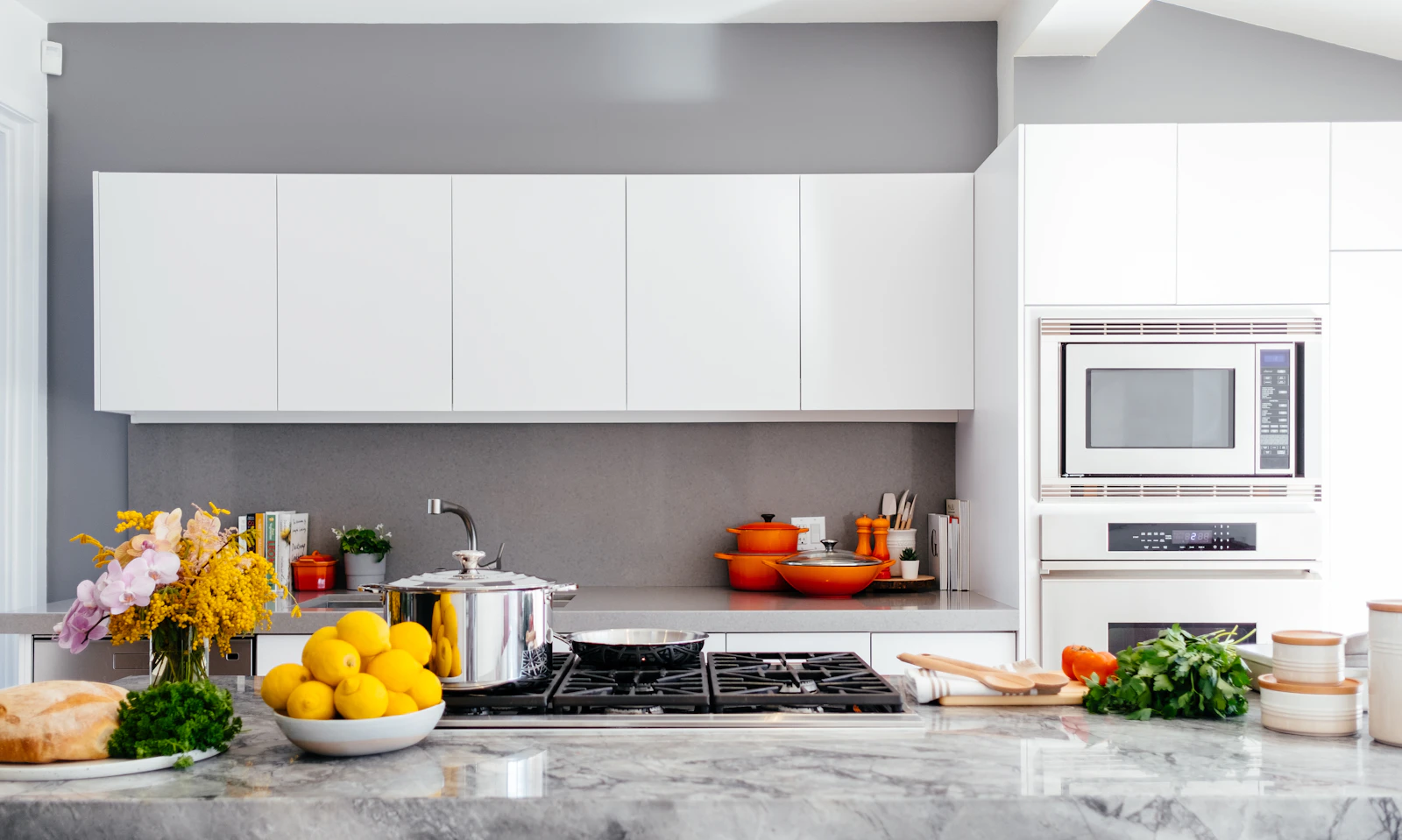
How much do quartz countertops cost?
Quartz countertops cost roughly $50–$150 per square foot installed, according to industry cost data from sources like HomeGuide and Angi, which puts a typical kitchen around $2,000–$5,000. Material grade, edge profiles, and how much countertop you have drive the range. Quartz has become a go-to for Florida kitchens for a practical reason: as an engineered, non-porous surface, it resists the moisture, stains, and bacteria that humidity encourages — without the sealing that natural stone needs. This guide covers the pricing and why quartz fits the climate.
Key takeaways
- Quartz countertops run about $50–$150 per square foot installed; a typical kitchen is $2,000–$5,000.
- Engineered quartz is non-porous — no sealing, and it resists moisture and stains.
- Quartz vs. granite (porous, needs sealing) vs. marble (soft, stains easily).
- Keep quartz indoors — Florida sun can discolor it, so it's not for outdoor kitchens.
- Grade, square footage, edge profile, and cutouts drive the price.
Table of contents
- What quartz countertops cost
- Why quartz suits Florida
- Quartz vs. granite vs. marble
- The outdoor-kitchen caveat
- What drives the price
- Where to start
- FAQ

What quartz countertops cost
Quartz is priced per square foot installed, with grade and detailing as the main variables. Here's the 2026 picture from HomeGuide's quartz countertop cost data:
| Factor | Typical figure | Notes |
|---|---|---|
| Installed (per sq ft) | ~$50–$150 | Includes fabrication and install |
| Typical kitchen | ~$2,000–$5,000 | Average counter area |
| Premium patterns/brands | toward higher end | Marble-look and designer lines |
| Edge profiles & cutouts | add to cost | Beveled/ogee edges, sink cutouts |
A worked example: outfitting an average Orlando kitchen with mid-grade quartz lands in the $2,500–$4,500 range installed, while a large kitchen with premium marble-look quartz, fancy edges, and an island runs higher. Counters are usually part of a bigger kitchen remodel, so factor them into that budget if you're doing the whole room.
Why quartz suits Florida
Here's the Florida case for quartz. It's an engineered stone — ground quartz bound with resin — which makes it non-porous. That matters in a humid climate because non-porous surfaces don't absorb moisture, resist staining, and don't harbor bacteria, all without needing to be sealed. Natural porous stones, by contrast, can absorb moisture and need periodic resealing to stay protected.
The result is a low-maintenance, durable countertop well suited to Florida kitchens — wipe-clean, stain-resistant, and consistent in pattern (since it's engineered). For homeowners who want the look of stone without the upkeep, quartz hits the mark, which is part of why it pairs so commonly with cabinet refacing and other kitchen updates here.
Quartz vs. granite vs. marble
The three popular stone surfaces behave differently:
| Surface | Porosity / upkeep | Notes |
|---|---|---|
| Quartz (engineered) | Non-porous; no sealing | Durable, consistent, low-maintenance |
| Granite (natural) | Porous; periodic sealing | Durable, natural variation, heat-tolerant |
| Marble (natural) | Porous & soft; stains easily | Beautiful but high-maintenance |
Granite is a strong natural option — very durable and heat-tolerant — but it's porous and needs periodic sealing to resist stains. Marble is stunning but soft and prone to staining and etching, making it the highest-maintenance choice. Quartz splits the difference: stone-like looks with non-porous, no-seal convenience. There's no single "best," but for a low-maintenance Florida kitchen, quartz is frequently the pragmatic pick.

The outdoor-kitchen caveat
One important Florida limitation: keep quartz indoors. The resins that bind engineered quartz can discolor, fade, or degrade under direct sun and heat, so quartz is not recommended for outdoor kitchens or sun-exposed surfaces — and using it outdoors typically voids the warranty. In a state with both abundant sun and a love of outdoor living kitchens, this catches people out.
For an outdoor kitchen, choose a surface rated for UV and heat — natural stone like granite, porcelain slab, or concrete designed for outdoor use. Indoors, quartz is excellent; outdoors, it's the wrong tool. So match the surface to where it's going: quartz for the indoor kitchen, sun- and heat-stable materials for the lanai.
What drives the price
Several factors move a quartz quote. The grade and brand of quartz span a wide range — basic solid colors to premium marble-look designer lines. Total square footage is the base. Edge profiles (a simple eased edge is cheaper than an ogee or mitered edge) add cost. Cutouts for sinks and cooktops, and seams on large or complex layouts, factor in. And removal of old countertops is sometimes separate.
Get the quote itemized by material grade, square footage, edges, and cutouts so you can compare fairly. Two quotes can differ mostly on quartz grade — a designer pattern versus a standard color — rather than labor, so know which tier you're pricing.
Where to start
Start by measuring your counter area and choosing a quartz grade that fits your budget and style. Our remodeling directory and Orlando city page list local fabricators and contractors, with more across the full directory. Get the quote itemized, keep quartz to indoor surfaces (sun-stable materials outdoors), and consider pairing it with cabinet refacing or a fuller kitchen remodel if you're refreshing the whole room.
FAQ
How much do quartz countertops cost in 2026? Industry cost data puts quartz countertops around $50–$150 per square foot installed, so a typical kitchen often runs $2,000–$5,000. Material grade, edge profiles, and the amount of countertop drive the range.
Why is quartz good for Florida kitchens? Engineered quartz is non-porous, so it resists moisture, stains, and bacteria without sealing — a real advantage in humid Florida, where porous stones can harbor moisture. It's durable and low-maintenance.
How does quartz compare to granite and marble? Quartz is non-porous and needs no sealing; granite is natural and durable but porous and needs periodic sealing; marble is beautiful but soft and stains easily. Quartz is often the low-maintenance choice for Florida kitchens.
Can quartz countertops be used outdoors in Florida? Generally no. Engineered quartz can discolor or fade under direct Florida sun and heat, so it's meant for indoor use. For an outdoor kitchen, natural stone or other heat- and UV-stable surfaces are better.
What drives quartz countertop cost? The quartz grade and brand, total square footage, edge profile, number of cutouts (sink, cooktop), and any seams. Premium patterns and complex layouts cost more than basic colors in a simple layout.